Scaling LLM-based Recommendation Traditionally, recommendation systems have used techniques like collaborative filtering and content-based filtering. While these methods have been effective, the advent of Large Language Models (LLMs) has opened a new frontier allowing for highly tailored recommendation experiences. They also come with additional challenges, especially at scale. This project looks at the challenges of building LLM-augmented recommender systems.

Geert Pingen
ML Engineer, Research Scientist
I help build and scale ML/AI systems, and make GPUs go brrrr for recommendation, retrieval, and agentic systems. Currently working as Head of AI Foundations at Schibsted. Before that, researching distributed, autonomous, and 🌱 carbon-aware systems at TNO.
Top tracks
Writing
Sustainable Computing The digital sector is expected to be responsible for 5% of global greenhouse gas emissions by 2025. Similarly it significantly impacts energy, water, and other natural resource consumption. And while large data centres near a 1.0 PUE and often run on green energy, indirect scope 3 emissions - for example in chip manufacturing - are difficult to monitor and therefore underreported. Moreover, these are not visible to end users, preventing them from making informed decisions.
Causal Discovery Can we let autonomous systems discover generic rules that govern their environment on their own? Causal discovery is a method that tries to capture cause-effect relations from a mixture of observational and interventional data, but effectively generating new causal variables remains an open problem. This project looks at automatically learning high level causal variables from raw large-scale unstructured data.
Federated Cloud As standardization of cloud native orchestration matures, the ease of creating and managing compute clusters similarly proliferates. Unfortunately, multi-cluster orchestration still has its issues, especially in resource-constrained edge environments. Can we build a robust interconnected fleet of mobile platforms that come and go at will, all sharing their compute resources and applications?
Hot Target Detection Hot targets such as wildfires and volcanoes have a devastating impact on the planet, our infrastructure, and health. Detecting hot targets early and monitoring their progress is important to successfully manage and control them. Studies have shown that wildfires can be detected in Landsat 8 imagery by using Top of Atmosphere (TOA) reflectance, but false alarms are frequent. In this project, I took a deep neural network approach to hot target detection in satellite imagery.
Ground Cover Analysis Ground cover analysis is used in smart agriculture applications to enable automatic treatment of crops, for instance by finding an optimal distribution of water or pesticide administration. This is especially helpful for farms located in third world countries, that have little access to high-tech machinery and a lot to gain in terms of crop yield. In this project, various methods of ground cover analysis were tested to help farmers in the Bangladesh delta cultivate their land.
AVES AVES is a video search application created to evaluate relevance feedback in multimedia retrieval systems, for an internship at TNO. The engine uses deep learned neural networks to detect concepts, and is based on the TNO-VIREO, and UTWENTE-PRFUBE systems. It incorporates a novel Rocchio-like relevance feedback algorithm to boost retrieval results, outperforming state of the art reranking algorithms.
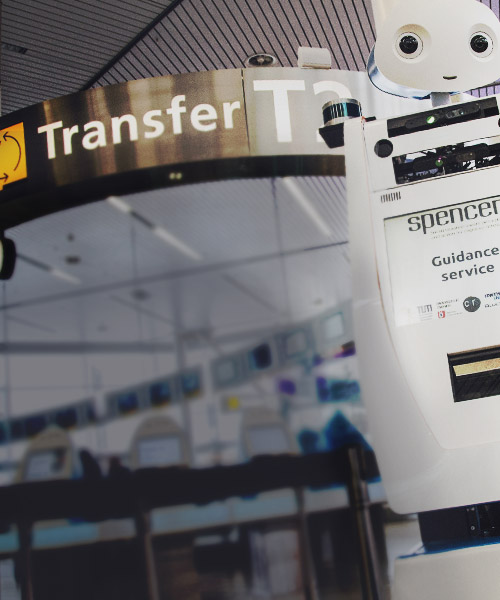
Guide Robot This project was aimed at researching the effects of head rotation and audiovisual feedback in guide robot behaviour. A robot was constructed for the purpose of guiding small groups of people around in an unfamiliar area. This research was conducted as part of the EU-funded SPENCER project (600877).
Monitoring Panic Attacks Panic disorder (PD) can be effectively treated with a variety of interventions, including psychological therapies and medication. In the great majority of cases hyperventilation is involved, exacerbating the effects of the panic attack. Deliberate deep breathing exercises help to rebalance the oxygen and CO2 levels in the blood. The aim of this project was to create a smartwatch app that monitors and aids patients suffering from PD.
Virtual Advertising Many sports events are broadcast on television with an overlay providing extra advertising space. In this computer vision project, virtual banners were placed inside existing clips of sports events using techniques such as line detection, camera auto-calibration, and perspective transforms.
Tracking People Streams During large scale events, e.g. pop concerts or busy places like railwaystaions, large numers of people pass eachother very closely. In order to direct these streams of people or in case of emergency to send help in the quickest way and direct these masses of people to exits, it is important to track such streams and recognize behavioural patterns.